Skip to content
  • Workplace & Career
  • Pop Culture
  • Social Media
  • Marketing
  • Parenthood

Unknown's avatar
Rikki Rogers is a writer, marketer, and career-loving parent living outside of Washington, DC.

Categories

  • Corporate Culture
  • Marketing
  • Parenthood
  • Pop Culture
  • Social Media
  • Uncategorized
  • Working It
  • Working It
  • Pop Culture
  • Marketing
  • Social Media
  • Parenthood
  • Uncategorized
  • Corporate Culture

Rikki writes.

Feminism, marketing, business, media, and their intersections

  • Workplace & Career
  • Pop Culture
  • Social Media
  • Marketing
  • Parenthood
  • Marketing

Why Do We Create Bad Content?

rikkirogers's avatar rikkirogers December 7, 2011

On December 1st I happily pressed play on my Pandora holiday station.  Unfortunately, in between my favorite seasonal hits (mostly featuring the Glee cast) I had to wait through 30 seconds of one of the worst ads ever.  It’s for The Cheesecake Factory, and it’s a jingle to the tune of “We Wish You a Merry Christmas.”

I tried and tried to find an audio clip of this horrifying ad, so you, dear reader, would have to experience my pain, but could not.  So you’ll have to sing it to yourself.  The ad goes like this:

We wish you a merry cheesecake

we wish you a merry cheesecake

we wish you a merry cheesecake

and a complimentary slice for you.

I’ve never before wanted to vomit after hearing about cheesecake.

Why doesn’t this ad work?  It’s uncreative.  It uses a holiday song, which has been re-appropriated thousands of times, and re-appropriates it again.  It shoves ten syllables into a final line that is intended for six syllables.

The Cheesecake Factory isn’t the only perpetrator of badly written content.   My parents’ house in Richmond, Virginia is surrounded by a smattering of uncreative content, particularly in the form of poorly chosen business names.  For example, the closest florist is named Flowerama.  The naming convention of adding “rama” to the end of a word should be reserved for roller skating rinks.   Just down the block from Flowerama is Chicken Mania, a Peruvian chicken, fast-casual restaurant that apparently doesn’t mind alluding to meat-borne diseases (does Mad Cow ring a bell)?  And finally there is Lettuce Knit, a knitting store which, despite what its name implies, is not also a salad bar.  (Lettuce Knit has sadly gone out of business.  I can’t say I’m surprised.)

Brands do this every day, and I just don’t understand.  The internet and social media provide an infinite amount of resources and opportunities for creative research, brainstorming, and even direct customer feedback, so there is no excuse.  Why didn’t an honest friend or family member  politely tell the owners of Lettuce Knit that their name was a recipe (pun intended, and relevant, unlike the name of the store) for disaster?

Perhaps businesses, both large and small, assume that because consumers are so inundated with messaging–on their cell phones, in the margins of their Facebook pages–that promotional content just doesn’t matter anymore.  Their potential customers are going to judge them based on Yelp and other social media reviews, not the name of their business.  Any content, good or bad, results in exposure, and they think that’s all they need.

But this assumption is wrong.  It’s true–consumers are bombarded with ads, but they are also bombarded with choices.  It’s the content created by brands that set them apart as a likable or unlikable business.  And, as we learned from Facebook, it’s all about what you like.

  • Pop Culture
  • Working It

Real Life Lessons from Someone Who Left A Job In “This Economy”

rikkirogers's avatar rikkirogers December 1, 2011

Back in July, when I announced to my friends and family that I was looking for a new job, many of them responded like so:  “Leaving your job?” they gasped, “in this economy?”

This economy has become the national catchphrase.  It’s used as a replacement for actual discussion of the complicated economic crisis we’re in and/or slowly climbing out of and/or setting up shop in, depending on who you’re speaking to.

This economy  is used by the local news to explain almost everything.  Bumper to bumper traffic on the beltway?  This Economy.  A mayor sexually harasses a woman and gets away with it?  This economy.  A bear breaks into a local woman’s kitchen?  This economy let him in.  

This economy has transformed into the formal equivalent of “HOLD! Whatever you are doing, don’t change anything.  A bunch of old dudes in Washington are working on it.  Do not move.”

But things weren’t changing for me a few months ago, and stasis didn’t seem like a smart option.

So I started looking for jobs.  And I found one.  And I adore it.  I work for a company that, despite this economy, is rapidly growing, treating its employees with respect and rewarding them with awesome perks and fantastic benefits.

Of course, job searching in this economy is tough.  It reminded me of dating: lots of pointless searching followed by rejection, and also the internet is there.  But I did end up with a wonderful job.

Here’s how I did it:

  1. I made applying for a job my second full-time job.  All job applications, all the time.  I forced myself out of bed at 5:30 every morning, applied to jobs until I went to work, and spent most of the evening doing the same.  Between July 29th and September 28th, I applied to almost 100 jobs, and wound up with a grand total of 7 interview requests.  I actually interviewed with 4 companies (declined the other interviews), and received 3 job offers.
  2. I cleaned up and developed my online identity.  I un-tagged Facebook bikini shots, updated my LinkedIn profile, and started tweeting.  I used Twitter wisely, to direct traffic to my blog and become involved in the marketing/social media/writing portion of the Twittersphere.  I also followed my potential employers on Twitter, Facebook, and LinkedIn to learn more about how they used social media and casually (or not) mentioned it during my interviews.
  3. I tried to stand out with innovative resume additions, like a link to my blog, links to my stories on The Daily Muse, and a Prezume.

I wouldn’t consider myself an expert, but I would encourage anyone out there that’s looking for a job to leverage social media and online tools as much as possible.  With so many people on the job market, it’s important to show your creativity and separate yourself from the masses.

  • Working It

On Embarrassing Myself

rikkirogers's avatar rikkirogers November 18, 2011

So here’s a fun fact about me: I embarrass myself a lot.   Tripping on the street, spilling a drink in a restaurant, dropping a medicine ball at the gym and watching it roll straight through an open door into a Zumba class, threatening the life of an eighty year old woman whose sight is compromised by her neon sweatband– these things happen to me.

When I was teaching at the University of Utah, I taught an entire class–the first class of the semester–with the back of my skirt unzipped.  And, yes, I used the chalkboard frequently.  I exposed my bright blue underwear to about twenty-five mostly Mormon undergraduates.

When I went to UVA, I accidentally ran  into an old man on the street.  I apologized, had a very pleasant five-minute chat with him, left the conversation assuming that he was senile and perhaps had Alzheimer’s–poor crazy old man!–only to find out, upon logging onto my computer a few hours later, that I had been speaking to our university’s president.  Maybe the condescending head-pat at the close of our meeting had been too much.

I once asked a friend-of-a-friend (who, in my defense, I hadn’t seen in a few years) to tell me about the process of adopting her baby boy, as I oohed and awed at her clearly Asian baby in the stroller, only to be told that she had actually delivered this baby girl via C-section.  There’s just no graceful way of exiting that situation.

So when I started my new job a few weeks ago, I made a promise to myself that I would not do anything embarrassing.  I checked and rechecked all buttons and zippers, brushed my teeth between meals, and memorized everyone’s names by heart.  Things were going well.  And then I walked into a glass wall.

(A side note:  interior designers must hate people.  Why do they, after so many years, continue to insist on putting floor-to-ceiling glass panes in the middle of nowhere?)

After walking into the glass wall, I immediately initiated my embarrassment-damage-control routine, which I’ve crafted and refined over the years.  It’s very efficient for diffusing embarrassing workplace situations, so I’ll share it with you:

  1. Laugh at yourself.  Make everyone around you seem very comfortable laughing at you too (they already are, so if you make them feel comfortable about it, you’ll avoid awkward, insincere apologies later).
  2. Tell everyone about it.  Logical thinking indicates that if you were really embarrassed, you wouldn’t want everyone to know.  So by telling everyone, you downplay your own embarrassment and come across as a super confident person who is impervious to the physical and emotional consequences of walking into a glass wall.   Also, like the laughing in #1, everyone is already going to talk about it, so let them hear it straight from the source.
  3. Get over it as quickly as possible.  This can be hard.  I tend to internalize these things.  But whenever I start thinking about (reliving) an embarrassing moment, I remind myself: you literally never have to experience that moment again.  That’s the only good thing about living in a world without time machines.
  • Working It

Colleagues and Cocktails: What to Drink at Happy Hour

rikkirogers's avatar rikkirogers November 5, 2011

My latest piece for The Daily Muse required a lot of research.  I’m still recovering.  Please check it out here!

  • Pop Culture
  • Social Media

Born with an Online Identity

rikkirogers's avatar rikkirogers November 1, 2011

My sister is pregnant (hooray!),  and I found out that her baby is a girl (even better!) via this ultrasound:

Yes, you just checked out the labia of a tiny, unborn child.  Pervert.

I currently have more than a few friends and family that are  pregnant or trying to be pregnant.  Every time I turn around someone else is refusing to have a drink with me.  As a result, I’ve become quite skilled at examining ultrasound images and feigning recognition when someone says, “Do you see the profile?”

In all honesty, the technology behind the ultrasound has made this easier and easier.  It’s pretty rare that, at least after a few hints, I can’t identify fingers, toes,or  a spine.

Mothers and grandmothers with grown children will tell you how much the technology surrounding pregnancy and childbirth has changed (if you’re in your late twenties, like me, your grandmother never had an ultrasound and could have been unconscious during delivery).   Many couples opt for 3D ultrasounds, provided by third party vendors charging a hefty fee, which provide unbelievably detailed pictures of your unborn baby.

It’s no surprise that the technology, specifically the ability to know so much about your baby before you meet him or her, has changed the way we talk about pregnancy, motherhood, and babies.  With this new and accurate prenatal information, parents are more likely to refer to their unborn baby by name, speculate on his or future personality, and create an identity for him before he or she is physically in the world.

I’ve written before about the impact of media, social media, and technology on the way we think about the world around us, and I find it particularly compelling that children born today will be born into a world that is already steeped in social media.   In fact, because so many parents post ultrasound photos and baby pictures on Facebook, announcing their children’s entrance into the world and chronicling it with daily photo updates, (which will only be enhanced with Timeline), children born today will always have a virtual identity, beginning with day 1 (or week 12).

How will my niece’s childhood be different than mine or her mother’s because of social media?  How will being born into Facebook (which, were it a country, would be the third largest nation in the world) affect her development?  Will taking over her Facebook account when she turns 13 (or the age that her parents deem appropriate) be a new right of passage, just as important as learning to drive or getting a cell phone?

As I’ve said before, I don’t support a doom-and-gloom outlook of social media, and so I am not implying that modern childhood will be worse, less rich, or less grounded.  But I do think that being born with both a physical and virtual identity is a cultural phenomenon worth investigating.

  • Working It

Costume Class: What to Wear to Work on Halloween

rikkirogers's avatar rikkirogers October 27, 2011

My most recent article for The Daily Muse will help you prepare for the always fun but potentially awkward office Halloween party.  Please check it out here!

  • Pop Culture
  • Social Media

Shopping Carts and Social Media: Why Are We Getting Lazier?

rikkirogers's avatar rikkirogers October 16, 2011

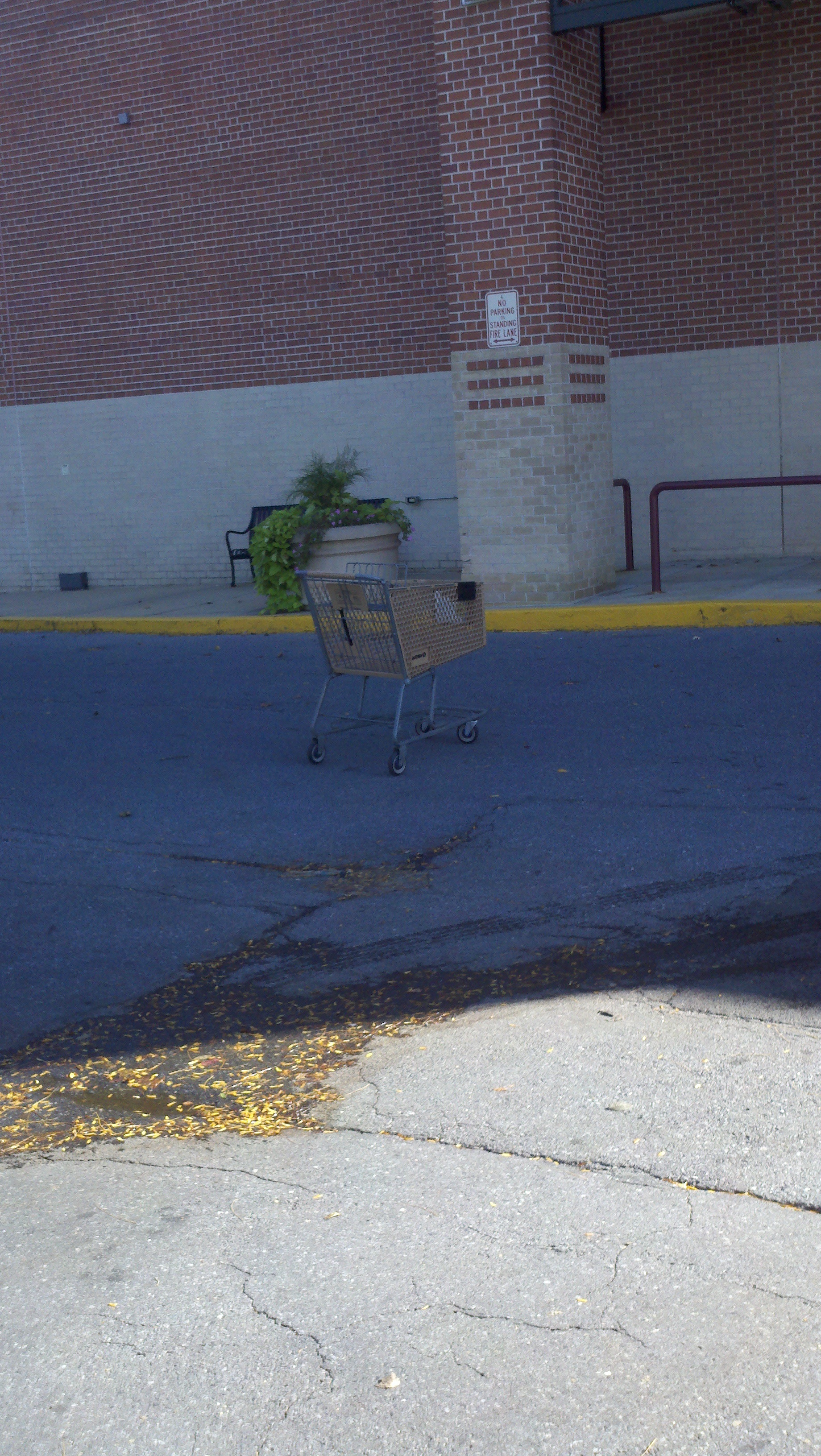
I came across this visual display of laziness during my grocery run today:

I know the photo is a little dark, so allow me to elaborate.  It’s a shopping cart in the middle of the grocery store’s main thoroughfare.  I had to drive around it.

I know what you “benefit of the doubt” people are thinking right now.  Maybe the wind blew it into the road!  Maybe its wheels went haywire and it rolled–independently–from the cart corral into the middle of traffic!  Surely no one would do this!

But, someone did.  In fact, several people did.  I witnessed a family load their groceries into their trunk, watch as their shopping cart rolled away from their Honda Odyssey, and proceed to climb into the van and drive away.

I don’t understand this willful ignorance of how your own inconsiderate actions–however small–can affect those around you.

Maybe this lack of awareness is a blessing.  As the van’s sliding door closed automatically at about 4 inches per minute, allowing the children in the backseat to watch the shopping cart come to a halt several feet from the sidewalk, they looked bored, but happy.

I, on the other hand, tend to over-think the consequences of the tiniest actions.  If I take off my socks in the middle of the night and fling them onto the floor, I imagine my husband getting up, slipping on the socks in the dark, falling violently, breaking his neck or injuring his back, and by the time I get up to put the socks into the laundry basket, I’m considering the logistics of adding a wheelchair ramp to the front of the house.

While the evidence isn’t always as photogenic as the shopping cart incident, I see instances of inconsiderateness every day: littering, smoking two feet from the building’s only covered entrance, texting when you should be paying attention to my compelling Powerpoint presentation.

You’d think that people would be more considerate now, given the increasing ease of connecting with and influencing other human beings.  Just a few decades ago, the average American kept in touch with far-off folks via letters and an occasional road trip, but the scope of their everyday interactions was much smaller: local friends, local family.

Today the internet and social media allow us to keep in touch with hundreds of people.  We can watch our high school friends grow up, do business with colleagues on the other side of the globe, and find distant relatives online.  We can view the intimate details of strangers’ lives online, creating a sense of empathy for someone we might otherwise disregard.

Yet the ability to communicate with other human beings more efficiently and more frequently has not made us more aware of those around us.  Your grandparents and parents might argue that it has made us more selfish and more aware of our own needs instead.

I don’t have an insightful conclusion here.  Maybe my observation is geographically biased, maybe Silver Spring, Maryland just has a high concentration of jerks.  But there must be some way for us to translate the “it’s a small world after all” effect of social media into “return your damn shopping cart, lazy.”

  • Working It

Why Your Job Search Is Like Going to Prom

rikkirogers's avatar rikkirogers October 11, 2011

I experienced an array of emotions during my recent job search: excitement, uncertainty, and insecurity, among others.  Each time I left an interview, I found myself replaying my responses over and over in my head, creating an endless list of possible misinterpretations of my words.  At one point I convinced myself that I hadn’t landed a job because a comment I made about a local frozen yogurt shop had been considered racist.

As I was torturing myself and staring longingly at my phone, waiting for a call from the employer of my dreams, I was overcome with a sense of deja vu.  Hadn’t I felt these feelings before–this fear of rejection, this need to be accepted and praised?  Oh yeah, high school.

While my instinct was to self-medicate the same way I would in high school ( ie scribble in my diary while sipping from a mug of Swiss Miss and blaring some Stabbing Westward on my boom box), I decided instead to write an article about it for The Daily Muse.  You can read it here.

  • Social Media

On Not Being Crafty

rikkirogers's avatar rikkirogers October 4, 2011

I’m not crafty (in the “arts-and-crafty” sense of the word, not in the “cunning” sense of the word.  Very much so cunning, not very crafty.)  My sister, my mother, and my aunts are very crafty, but somehow I didn’t inherit the trait.  I tend to fail at anything that requires manual dexterity.

I rarely feel insecure about my lack of craftiness.  With the exception of Christmas day, when my female relatives reveal handmade masterpieces that cost them less than the fortune I’ve managed to spend on presents most likely made by Asian children, I’ve always felt pretty neutral about my craft skills.   Who cares if I can’t cut a straight line, much less a scalloped edge?

This has all changed because of the wonderful, evil site, Pinterest.

Pinterest is a website, inspired by social media faves Facebook and Twitter, that allows users to share “beautiful things”– art, photography, home design, clothes, and crafts.  Anything you find on the internet can be pinned and saved to Pinterest.

Although Pinterest can be used to share images of clothes, books, and even celebrities, do-it-yourself crafts occupy the majority of Pinterest space.

Because of crafts’ dominance on Pinterest, it has become, for me, a craft-bully, constantly reminding me how inadequate I am for being unable to do-it-myself.  Why is Pinterest so effective at  instilling shame in the non-crafty?

1. It’s social.  When you join Pinterest, you can import and follow your Facebook and Twitter friends as well as your contacts from Gmail, Yahoo, etc.  This means that the homemade items you see on Pinterest aren’t just display items at Michael’s, they are projects that your friends and family have actually completed and will be shoving into your stocking with a handmade card.  Not to mention that your friends and family can follow you and see what you’ve pinned, ie what you (I) will eventually fail at creating.

2. It’s never-ending.  The landing page of Pinterest, once you’re a member, is a stream of your friends’ pins.  This page literally never ends.  I’ve tried to reach the end of Pinterest, unsuccessfully, by dragging the scroll bar to the conclusion of the page, only to see it rise again, as if by magic, while Pinterest informs me that it is “loading more Pins.”   There’s no natural pause point for viewing craft after craft, which leads un-crafty people, like me, into a bottomless shame spiral.

3. It capitalizes on the home decorating craze.  I’ve only recently weened myself off of House Hunters, Income Property,  Color Splash, Holmes on Homes, and Property Virgins.  I’m now down to only 2 marathon DVR sessions per week.  Pinterest has leveraged the home decor madness that has allowed TLC and HGTV (previously deemed  “Hey Grandma TV” by one of my uncles) to become hip and mainstream.

3. Therefore, it’s addictive.  Because it combines the time-sucking powers of social media and the home decor craze, and because it is designed to be a bottomless pit of impossible (for me) crafts, Pinterest is like craft crack.

In order to improve my poor do-it-yourself-esteem, I’m going to tackle some “beginner” crafts between now and the holidays.  To give you an idea of how it’s going so far: The first craft I began, which required only three items (buttons, straight pins, foam) ended a in complete and total failure,  inducing my husband (who was trying to make me feel better) to exclaim,  “But you’re crafty with words!”

  • Pop Culture

Hating on Hallmark

rikkirogers's avatar rikkirogers September 29, 2011

Hallmark’s new line of job loss cards has reminded me how much I hate greeting cards.

With the exception of a few hilarious cards I’ve received throughout my life (I do love those cards with the 1950’s ladies with sarcastic captions), I’ve never received a birthday, holiday, or congratulatory card with a message that has moved me.

Of course, it would be difficult for Hallmark’s prose to emotionally affect me, considering that I never actually read the card.  If I open an envelope to find a pastoral scene superimposed with lacy script, I immediately ignore those words and move to the second page of the card.  I’m interested in reading the words of the friend or family member who sent me the card, not those of a stranger who was paid to write it.  The stranger isn’t really wishing me a happy birthday, isn’t familiar with my kind heart, and couldn’t possibly know whether or not I have “earned it!”

Many people find themselves in the card aisle debating between a handful of hackneyed messages because they aren’t confident in their own writing ability.  But even a novice writer can successfully compose a sincere note.   As an experienced purchaser of “blank inside” cards, I can give you a few pointers:

If you’re going to quote, choose a quote that’s meaningful to you:  Are you tired of people telling you to dance like no one is watching or to live, laugh, and l0ve?  So are your friends and family.  Instead of using these tired quotations, do some research and find one that is personally relevant to you.  Write it on a card, explain why you think it applies to the present occasion or  for the receiver of the card, sign your name–voila!–  a heartfelt card.

Stay focused.  When you’re writing to someone that you share a history with–a friend, a sibling, a parent–it’s easy to become verbose.  Write sincerely, but simply.

Don’t stress.  Many people tense up at the thought of expressing themselves in writing.  Remember that you are writing on a paper card, not a headstone.  Chances are this is not the first nor the last opportunity you’ll have to write this person.

After my now-husband proposed to me, my grandma sent me a handwritten note on a blank-inside card.  On the front of the card were two fairies in fall-like colors, gazing longingly at one another from opposite boughs of a tree.  On the inside were two full 5×7 pages of marriage advice.  My grandma was happy for me, but she did not mince words: I had just made an important commitment and I better be prepared.  An excerpt:

Marriage is a serious commitment.  “Love” is very important, “best friends” is necessary.

Take that, Hallmark!  She wrote that for free.  

Posts pagination

Previous 1 … 7 8 9 10 Next
Blog at WordPress.com.
  • Subscribe Subscribed
    • Rikki writes.
    • Join 36 other subscribers
    • Already have a WordPress.com account? Log in now.
    • Rikki writes.
    • Subscribe Subscribed
    • Sign up
    • Log in
    • Report this content
    • View site in Reader
    • Manage subscriptions
    • Collapse this bar
 

Loading Comments...