Skip to content
  • Workplace & Career
  • Pop Culture
  • Social Media
  • Marketing
  • Parenthood

Unknown's avatar
Rikki Rogers is a writer, marketer, and career-loving parent living outside of Washington, DC.

Categories

  • Corporate Culture
  • Marketing
  • Parenthood
  • Pop Culture
  • Social Media
  • Uncategorized
  • Working It
  • Working It
  • Pop Culture
  • Marketing
  • Social Media
  • Parenthood
  • Uncategorized
  • Corporate Culture

Rikki writes.

Feminism, marketing, business, media, and their intersections

  • Workplace & Career
  • Pop Culture
  • Social Media
  • Marketing
  • Parenthood
  • Parenthood
  • Working It

Does Your Dream Job Fit Into Your Dream Life?

rikkirogers's avatar rikkirogers August 26, 2013

A cursory read-through of my high school diaries reveals that I dreamed of becoming a political speech writer, a novelist, a poet, an ad copywriter, a parent, and, of course, a millionaire. I assumed that, no matter which path I chose, I would make more money than I’d know what to do with.

By college, I was more realistic. As an English major and, later, as a graduate student in creative writing, I knew that fame and fortune weren’t likely. But I still assumed that I would eventually find a concrete representation of my imaginary ideal: a full-time writing gig with unlimited upward mobility that would keep me employed for the rest of my life. Everything else (money, lifestyle, parenthood) would fall into place.

Now that I’m nearing 30 and have a son, I realize that my conception of a dream job was, well, a misconception.

Read more on The Daily Muse.

  • Marketing

Content is King, and We’re Ruining His Rep

rikkirogers's avatar rikkirogers July 22, 2013

The modern buyer is connected, social, and able to learn about you and what you’re selling on her own. This is true whether you’re in the B2B or B2C world. When your buyer researches your product, she isn’t looking for a pitch, she’s looking for credibility. Content — beautifully written blog posts, hilarious videos, ironic memes, or even simple, easy-to-follow instructions — provides the credibility and likability your buyer wants to see.

And what marketer wouldn’t produce content when, according to Hubspot (a prolific content producer itself), companies that post more than 15 blogs each month get 5 times as much website traffic?

This deck shares some of the most compelling stats about content marketing, but the main point is this: There’s a lot of content out there. Nine out of ten companies market with content. There are 27 million pieces of content shared each day. 86% of B2C marketers and 91% of B2B marketers use content marketing. And, this stat is one I discovered on my own, 100% of people don’t have time to digest all this crap.

As a marketer actively engaged in content marketing, I am overwhelmed by the amount of content in my Twitter feed. Some brands are getting it right, creating content that I genuinely want to read, watch, and share. (Examples from my current space: Salesforce, Econsultancy, CEB), while others are getting it wrong, publishing repetitive fluff that masquerades as substantive content. The fluff, though, detracts from the good stuff, and gives all of content marketing a bad reputation. Buyers are tired of sifting through blog posts listing the same 3 things the most successful people do every morning. They’ve read all the must-read tips. Their calendars are full of redundant webinars, and their inboxes overflow with vague whitepapers.

To make sure your marketing strategy lands in the substantive camp:

1. Use a real writer. If you’re planning on producing written content, you must fully board the content marketing train by hiring a creative, articulate writer (or finding one within your company) who’s familiar with your industry and your target market. Don’t assume that anyone with a Twitter account and some WordPress experience can do this for you. Look for writers who can help you develop an approachable, trustworthy tone and are familiar with writing for the web.

2. Don’t copy, just link. Too many content producers surf the twittersphere for what’s trending and then write a not-quite-plagiarized version of someone else’s content. There’s nothing wrong, though, with simply asking permission to re-blog someone else’s content and give them credit. The original author will usually gladly accept, you’ll get just as many reads (or more, since the original content is probably better than your paraphrased version), and you’ve created grounds for a potential partnership.

3. Collaborate. People like to hear from the experts, and inviting them to share their knowledge through your content channel is a great way to build credibility. Ask clients, partners, and executives (or other internal leaders) to guest author blogs, co-write ebooks, or star in a video.

4. And speaking of video, use it wisely. It’s true that, in our “crazy busy” world, buyers are more likely to watch a video than read an article. But videos still need a writer to develop a storyline, align it with existing messaging, and draft a script that lends itself to natural delivery.

How are you ensuring that your content breaks through the clutter? Tweet me @rikki_rogers.

  • Working It

Working on It: A Column For Career-Loving Parents

rikkirogers's avatar rikkirogers July 19, 2013

I’m thrilled to be launching a column for The Daily Muse entitled “Working On It: A Column for Career Loving Parents.”

Read the column’s first installment here.

And check out the second installment on July 29.

  • Working It

Why You Should Talk Sports in the Office (and How to Get Started)

rikkirogers's avatar rikkirogers May 3, 2013

I didn’t start following any sports teams until I entered the working world. I had no reason to—my athletic abilities don’t go much past 7.0 on the treadmill, my hometown hosts no major athletic teams, and my alma mater’s football record has been inconsistent at best (humiliating at worst) for the past decade.

Then, I married a man who can recite the names, stats, eye color, and astrological sign of every professional athlete since the 1970s. I slowly started absorbing some of this knowledge and—to my surprise—I enjoyed it. Cut to a few years later, and I watch ESPN, listen to local sports radio, and instead of counting sheep to cure insomnia, I name players from my local teams in reverse alphabetical order.

Better yet, I found that my new hobby helped me out quite a bit in the office. Even if you’re not a sports fanatic, being able to hold your own in a conversation about last weekend’s game is a professional skill you shouldn’t underestimate. Local sports create common ground for friendly office small talk (unless you’re a Cowboys fan outside of Texas), not to mention that “field trips”to local games are still a favorite reward option and a popular client gift.

Read the rest of this piece at The Daily Muse.

  • Working It

Professional Woman’s Guide to Surviving Maternity Leave

rikkirogers's avatar rikkirogers March 19, 2013

As a new mom, I felt prepared for many aspects of life with a newborn: the sleepless nights, the numerous trips to the pediatrician, the emotional rollercoaster that transported me back to my angsty teenage days (only now I’ve replaced my babydoll tee with a baby sling and wear a lot less eyeliner). But what I wasn’t prepared for is the new mindset I would have to suddenly commit to, one that’s completely antithetical to my usual working woman brain.

Let me explain: Your first few weeks as a mom comes with a series of paradoxical feelings. You are incredibly busy yet unbearably bored. You accomplish so much (I kept a child alive with nothing but my breasts and a bouncy seat!), yet get nothing done (I’ll never have a clean kitchen again). You feel protective and confident (Don’t tell me what to do with my baby, Mom!), yet clueless and insecure (I have no idea how to raise a child). It’s enough to drive any woman, especially one who’s accustomed to organized project plans and punctual kick-off meetings, crazy.

Read the rest of my article on The Daily Muse.

  • Marketing

Marketing Lessons from a New Mom

rikkirogers's avatar rikkirogers January 22, 2013

I’ve recently had a major life event — I’ve changed demographics. That’s right, I’m no longer a married woman 25-34. I’m now a married mother 25-34, children 2 and under. The boxes I tick off are totally different now. It’s been life-altering.

I wrote a few months ago about how I was marketed to as a mother-to-be and some of the opportunities I thought marketers were missing. As a new mom, I’m still a prime target for a slew of products. But just as I did during my pregnancy, I see major marketers missing opportunities and, frankly, making some mistakes when targeting women like me.

First, companies need to be completely transparent with new parents about how they’ve collected their contact information. One of the many lovely results of post-partum hormonal changes is a heightened, almost animal compulsion to protect your baby at all costs, and it’s quite alarming when baby products show up at your doorstep that you haven’t ordered.  The biggest perpetrator here are the formula companies, Enfamil and Similac, who sent whole cases of formula with congratulatory notes addressed to me by first and last name. I also received personalized offers from Huggies, Pampers, and Disney Movies, among others. How did they get my name and address? How did they know exactly when my child would be arriving? Chances are they purchased my information from another company I actually signed up to do business with, like BabyCenter or myregistry.com, which ask for your name and due date when you set up your account. The last thing marketers should want to do is turn off new moms — in their already paranoid state — by making them think about the public nature of their whereabouts. These companies should broadcast their affiliations in bright bold letters, not bury it in fine print.

Marketers should also consider the timing of their advertising. Case and point: less than eight hours after I gave birth to my son, a photographer walked into my hospital room and asked if I wanted to schedule and purchase newborn photos. I had been awake for 36 hours and was trying to nurse my baby for the third time in my life, so, needless to say, I was not in the mood to be sold. When I declined, she tried to get my email address so they could send me follow-up offers.  I was not amused. Fast forward five weeks, and I’m dying to spend money, most likely because going to Target is one of the only activities I can successfully manage with my baby. If I were to receive some offers in the mail now for, say, nursing-friendly dresses or large bags of ground coffee, I would head to the store in a heartbeat.

Finally, product marketers need to ensure that their product or service is easy to use. And by easy, I mean that I can use it one-handed. I’m not just referring to physical objects here (like Medela’s hands-free breast pump — genius), but also to services like websites and apps. For example, I was able to create my birth announcements on Shutterfly with one hand while simultaneously breastfeeding. It took four minutes. And you can bet that a year from now, when I’m choosing Christmas cards or birthday invitations, that I’ll return to their site. By contrast, if your product requires two hands or is in any way difficult or frustrating, I’m bailing. I downloaded a breastfeeding tracker app that took about 30 seconds to open on my iphone. That 30 seconds is the difference between my son patiently waiting in my arms and screaming bloody murder, so the app-maker promptly lost me as a user.

  • Pop Culture

5 (Almost) Free Gifts for your Family

rikkirogers's avatar rikkirogers December 11, 2012

‘Tis the season to give and receive crap you don’t need. Break the junk cycle by giving an affordable, thoughtful gift that your family might actually like.  Check out this piece I wrote for The Daily Muse last year about thoughtful, cheap gifts — an oldie but a goodie!

  • Working It

Making the Most out of a Conference

rikkirogers's avatar rikkirogers December 3, 2012

Attending a conference can be overwhelming. The huge convention centers, the pushy sales people, the agenda that’s roughly the length of a Victorian novel—it’s easy to find yourself mindlessly roaming the exhibition floor for days, leaving the conference exhausted and bewildered, with sore feet as your only key takeaway.  Check out my six tips for planning ahead to make each conference experience a productive one.

  • Marketing
  • Uncategorized

How I’m Marketed To As a Mother-To-Be

rikkirogers's avatar rikkirogers September 16, 2012

As I said in my recent article for The Daily Muse, people lie to pregnant women all the time.  They tell you that you look more beautiful ever, that they don’t judge the baby names you’re considering, that they can barely notice the varicose vein sprawling across your shin like a mountain range.

Of course, people tell these white lies to pregnant women because as a culture we (mostly) collectively agree that pregnant women deserve extra-special treatment.

So it’s no surprise that once you become pregnant, the marketing that targets you dramatically shifts in messaging.  One thing What to Expect When You’re Expecting didn’t prepare me for: spam.  Since I’ve become pregnant, the amount of spam in my inbox (and mailbox) has nearly doubled.  I don’t know how they do it.  (Though this gives me some ideas.) I bought two maternity tops and suddenly I’m subscribed to Parenting magazine, Pampers emails, and a barrage of parenting e-newsletters which are essentially random, unorganized tips planked by columns of ads.

The quantity of ads isn’t what gets me, though.  Instead, I’m puzzled by how misguided, and sometimes insulting, many of these ads are.  For example:

Ads targeting pregnant women rely on the decapitation effect quite a bit, picturing just a pregnant belly and breasts, reminding you of what you really should be focusing on.  Forget about the needs of your brain and legs, your belly is what requires your attention.  And, of course, the best way to show your unborn child your unconditional love is to buy stuff.

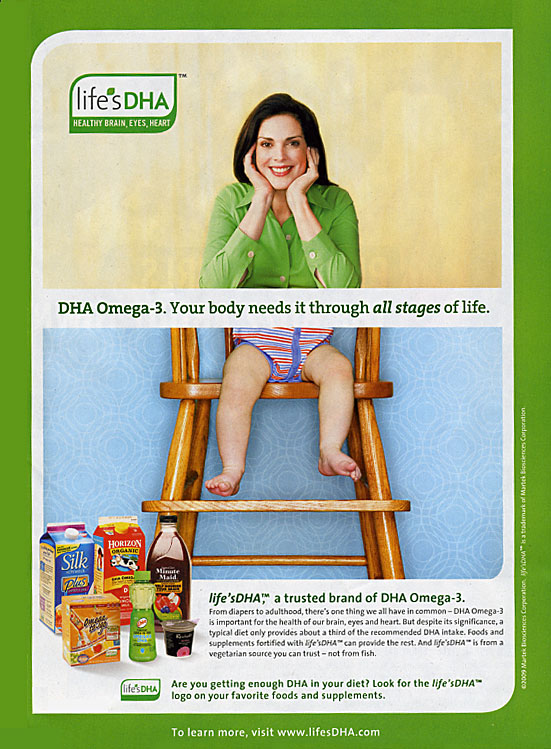
Other companies assume that because you are with-child, you suddenly have childlike tastes and need cartoons to help you understand complex messages like “Kids might need Vitamin D.”

The frustrating part about these ads for me, as someone interested in media and marketing, is that advertisers are missing a huge opportunity here.  More than any other time in my life, I am paying attention to what I buy.  I need detailed descriptions of products, their long-term benefits, and an argument of their quality compared to their cost.  I am turning toward brands that I trust.  I have a list on my iPhone not of things that I want to buy, but things that I must buy, in a very specific timeframe.  In other words, I am a marketer’s dream.

But I am also hypersensitive to marketing right now, as I am constantly shopping.  I am receiving unsolicited advice from everyone I meet, and I ‘m required to report my daily decisions to family, friends, and doctors.  The last thing I want is to look at an ad that makes me feel guilty or takes advantage of my anxiety or fear, like this one

or ads that refuse to acknowledge me as being an autonomous human being, separate from my child or role as a mother:
So what can marketers do to win over moms (well, at least this mom?)

1. Get social and play up the testimonials.  I trust the opinions of other parents above all else right now, so if a brand allows (and encourages) parents to share feedback and testimonials, I’ll pay more attention to authentic reviews more than any other content.  Along the same lines, brands should be using social media in two-way communication with parents that have questions pre and post-purchase.  If I see that product support will be fast and easy, I’m more likely to buy.

2. Prove that your product deserves a spot in my overcrowded home. Many ads fail at demonstrating the long-term value of their product because they are too focused on manipulating my emotions with an adorable newborn or a smiling infant.  What they’re forgetting, though, is that parents are concerned with clutter just as much as childcare.  We leave our baby showers,  and think, Where I am going to put a baby now that I have all of this stuff?  Showing that your product will last and can be used over the years (for the child as she grows or for second or third children) will speak volumes to parents.

3. Don’t spam me.  If parents begin to associate your brand with privacy concerns, they’ll never buy from you.

4. Give me a deal, but make it one that I can use easily.  When I registered for my baby shower at Target, they sent me home with a book of coupons with very long expiration periods, plenty of time for me to redeem.  I’ve already used several, and bought other full-priced items once I was in the store.  This type of deal worked: I returned to the store and I was upsold.  But when I went to a popular maternity store and was given rewards points that I could redeem only during a certain week and use only on specific items and had to save both the points receipt and my original receipt, I just threw all that crap away.  Baby brain is a real thing, and there’s no way I am going to return to a store on a certain date and sort through racks to save a few bucks.

Attention parents-to-be, how do you feel about the way products are marketed to you?  Are you paying attention to ads or tuning them out?  What brands are winning your hearts, and what brands are winding up in your recycling bin?  Tweet me @rikki_rogers.


  • Marketing

What Cafe Rio can teach us about marketing

rikkirogers's avatar rikkirogers September 2, 2012

I love Cafe Rio.  It’s a fast-casual Mexican restaurant.  (Think Chipotle, but ten times better.)  Cafe Rio had me as a brand advocate from the beginning.  And even though the Mexican QSR does have an online presence (Twitter handle @caferio and a frequently updated blog), Cafe Rio won my heart the old-fashioned way.  Why do I find this brand so attractive?

  1. They have a story.  Cafe Rio was founded in Salt Lake City (I discovered the eatery when I was living in Salt Lake City attending graduate school).  According to local lore, two brothers opened the restaurant and earned immediate fame with their pulled pork burritos.  The pulled pork was so delicious because it was slow cooked in Dr. Pepper.  But some family feud drove the two brothers apart, and one of the brothers opened a second, separate restaurant, Costa Vida, with a nearly identical menu, except that the pulled pork is soaked in Mr. Pibb.  Is this story true?  I have no idea.  The details are a little shaky (was Cafe Rio or Costa Vida the original?  I’m not sure.)  Regardless, the back story gives the brand some drama, and helps customers both remember and connect with it.
  2. They have fantastic customer service.  I’ve visited Cafe Rio in Utah, Maryland, and Virginia, and each one is staffed with friendly, professional people.  They say hello when you come in.  They sing a little song when you redeem a free meal (oh, and they give you free meals occasionally.)  They answer your (my) annoying questions about what is and isn’t vegetarian.  It’s clear that the customer service training is an important part of the on-boarding process for new hires.
  3. They have a quality product.  Obviously, I wouldn’t be raving about Cafe Rio if their food was only so-so.  Everything, from their handmade tortillas to their tres leche cake to their mint limeade (insider tip: get a cup of this to go, add rum when you get home, and that’s the best mojito you’ve ever had!), is fresh and delicious.  Additionally, their menu exceeds those of other Mexican QSRs because it features more than the usual rice, beans and meat.  They offer fish tacos, cocoanut rice, and as well as pork, beef and chicken prepared two ways.
  4. They have a distinct, consistent marketing voice.  The voice of the brand is clever and consistent across platforms, from the signs in their stores to their Facebook wall posts.  For example, in their stores, above their shelves of beautifully arranged lemons, limes, and peppers, they have a sign that says “Yes, these are real.”  And their Facebook posts are typically along these lines:

or this

The personality created for their brand is authentic and engaging and invites customers to participate with the brand through contests or just a little chuckle.  They’re  not sales-y, pushy, or — and this is important — over-the-top ironic, which can get old (fast) and typically appeals to an exclusively younger crowd, as opposed to people of all ages.

Notice that two of the four qualities that make Cafe Rio a candidate for brand loyalty have nothing to do with positioning — it’s the product.  The product is the foundation of the marketing strategy, as it must be with all campaigns.

What brands keep you coming back with a killer product and clever marketing?  Tweet me at rikki_rogers.

Posts pagination

Previous 1 … 4 5 6 … 10 Next
Blog at WordPress.com.
  • Subscribe Subscribed
    • Rikki writes.
    • Join 36 other subscribers
    • Already have a WordPress.com account? Log in now.
    • Rikki writes.
    • Subscribe Subscribed
    • Sign up
    • Log in
    • Report this content
    • View site in Reader
    • Manage subscriptions
    • Collapse this bar
 

Loading Comments...