
Like high school bullies of days past, Workplace Bullies use intimidation, public humiliation, and insults to manipulate those around them. But unlike high school, you don’t have to put up with them for the sake of looking cool. In my latest article for The Daily Muse, I identify three bullies you’re likely to meet at work and suggest how you can take the high road.
Category: Working It
Dress for Success (and Credit Card Debt)
When it comes to the interview look, who can afford to be forgettable in a competitive work environment?
–Marie Claire “Outfit 911”
Like many fashion magazines, Marie Claire makes an effort each month to provide content for the “career oriented” woman. Gone are the days when a fashion magazine can publish page after page of uninterrupted dieting, fashion, and sex advice. Now they punctuate their beauty features with serious stories, and many of them are worth the read. Marie Claire‘s February edition, for example, includes an interview with South Carolina governor Nikki Haley and Pulitzer Prize winning journalist, Katherine Boo.
Since many “career-conscious” women (and men) are out of work or looking for better opportunities, fashion and lifestyle publications now offer advice on how to dress for a job interview. Marie Claire’s February “Outfit 911” spread focused on clothing that will help you “Nail That Interview.” Here’s a sampling of the essential outfit elements they suggest:
A $645 jacket

A $625 Max Mara button-up white blouse

A $415 Alexander Wang cropped sweater (and you know how I feel about cropped clothing)

As well as a watch, a ring, and a purse whose prices are “available upon request.”
At the conclusion of the dress for success piece, a tiny text box asks readers, “Need some more ideas for work-worthy looks that won’t break the bank?” Some more ideas? How about a single item under $500 (there’s none — save a bottle of nail polish at $15).
The disconnect between the message of the feature and the products it proposes as reasonable remedies is a common theme in beloved magazines like Marie Claire and Glamour, and even fitness/beauty magazines like Shape and Self. They fervently promote the idea of the independent woman, make plenty of space in their publications to discuss the importance of health over beauty, and descry the unrealistic and harmful standards of beauty women learn from a young age. But, nevertheless, they are funded by advertisements of beauty products and clothing lines, which they must sell. (Susan Douglas explores this tension at length in her book, Enlightened Sexism.)
Magazines like Marie Claire and Lucky are my guilty pleasures. They’re great for a light read at the end of the day. I do enjoy their exercise tips, profiles of unsung women, and the way the models’ flat stomachs and perfect thighs make me feel all warm and confident inside.
But I take their beauty and health guidance with a grain of salt. It’s no coincidence, for example, that the moisturizer featured in a full-page glossy ad appears as an essential item for your “beauty toolbox” a few pages later. (Even Real Simple starts its publication with a list of things you need to buy for the purpose of de-cluttering.) Though they’ve certainly come a long way, fashion magazines are still “advertorial,” and the media-smart reader should keep that in mind before they buy “Marie Claire‘s five Fall favorites!”
(If you’re really looking for the perfect interview outfit at a reasonable price, H&M, TJ-Maxx, Marshall’s, and Nordstrom Rack should be your go-to places. I landed a new job a few months ago and dug all of my interview-wear out of overstuffed racks at these stores.)
What Do the Post WWII Economy and the Deep-in-Recession Economy Have in Common?
In my newest article for The Daily Muse, I show how some of the arguments we’re having about gender divisions in the workforce call upon ideas that prevailed as soldiers were returning home after WWII (you know, before the bulk of the feminist revolution took place). Please read it here.
What to Drink (When You’re Not Drinking)
A couple months ago I wrote a story for The Daily Muse about respectable after-work drinks, entitled Colleagues and Cocktails: What to Drink at Happy Hour. A Daily Muse reader suggested that I write a follow-up story about non-alcoholic choices. I agreed that this was a great story idea– many professional women aren’t drinking because they’re pregnant, trying to lose weight or save money, etc. That article is out today– just in time for The New Year. You can check it out here.
Real Life Lessons from Someone Who Left A Job In “This Economy”
Back in July, when I announced to my friends and family that I was looking for a new job, many of them responded like so: “Leaving your job?” they gasped, “in this economy?”
This economy has become the national catchphrase. It’s used as a replacement for actual discussion of the complicated economic crisis we’re in and/or slowly climbing out of and/or setting up shop in, depending on who you’re speaking to.
This economy is used by the local news to explain almost everything. Bumper to bumper traffic on the beltway? This Economy. A mayor sexually harasses a woman and gets away with it? This economy. A bear breaks into a local woman’s kitchen? This economy let him in.
This economy has transformed into the formal equivalent of “HOLD! Whatever you are doing, don’t change anything. A bunch of old dudes in Washington are working on it. Do not move.”
But things weren’t changing for me a few months ago, and stasis didn’t seem like a smart option.
So I started looking for jobs. And I found one. And I adore it. I work for a company that, despite this economy, is rapidly growing, treating its employees with respect and rewarding them with awesome perks and fantastic benefits.
Of course, job searching in this economy is tough. It reminded me of dating: lots of pointless searching followed by rejection, and also the internet is there. But I did end up with a wonderful job.
Here’s how I did it:
- I made applying for a job my second full-time job. All job applications, all the time. I forced myself out of bed at 5:30 every morning, applied to jobs until I went to work, and spent most of the evening doing the same. Between July 29th and September 28th, I applied to almost 100 jobs, and wound up with a grand total of 7 interview requests. I actually interviewed with 4 companies (declined the other interviews), and received 3 job offers.
- I cleaned up and developed my online identity. I un-tagged Facebook bikini shots, updated my LinkedIn profile, and started tweeting. I used Twitter wisely, to direct traffic to my blog and become involved in the marketing/social media/writing portion of the Twittersphere. I also followed my potential employers on Twitter, Facebook, and LinkedIn to learn more about how they used social media and casually (or not) mentioned it during my interviews.
- I tried to stand out with innovative resume additions, like a link to my blog, links to my stories on The Daily Muse, and a Prezume.
I wouldn’t consider myself an expert, but I would encourage anyone out there that’s looking for a job to leverage social media and online tools as much as possible. With so many people on the job market, it’s important to show your creativity and separate yourself from the masses.
On Embarrassing Myself
So here’s a fun fact about me: I embarrass myself a lot. Tripping on the street, spilling a drink in a restaurant, dropping a medicine ball at the gym and watching it roll straight through an open door into a Zumba class, threatening the life of an eighty year old woman whose sight is compromised by her neon sweatband– these things happen to me.
When I was teaching at the University of Utah, I taught an entire class–the first class of the semester–with the back of my skirt unzipped. And, yes, I used the chalkboard frequently. I exposed my bright blue underwear to about twenty-five mostly Mormon undergraduates.
When I went to UVA, I accidentally ran into an old man on the street. I apologized, had a very pleasant five-minute chat with him, left the conversation assuming that he was senile and perhaps had Alzheimer’s–poor crazy old man!–only to find out, upon logging onto my computer a few hours later, that I had been speaking to our university’s president. Maybe the condescending head-pat at the close of our meeting had been too much.
I once asked a friend-of-a-friend (who, in my defense, I hadn’t seen in a few years) to tell me about the process of adopting her baby boy, as I oohed and awed at her clearly Asian baby in the stroller, only to be told that she had actually delivered this baby girl via C-section. There’s just no graceful way of exiting that situation.
So when I started my new job a few weeks ago, I made a promise to myself that I would not do anything embarrassing. I checked and rechecked all buttons and zippers, brushed my teeth between meals, and memorized everyone’s names by heart. Things were going well. And then I walked into a glass wall.
(A side note: interior designers must hate people. Why do they, after so many years, continue to insist on putting floor-to-ceiling glass panes in the middle of nowhere?)
After walking into the glass wall, I immediately initiated my embarrassment-damage-control routine, which I’ve crafted and refined over the years. It’s very efficient for diffusing embarrassing workplace situations, so I’ll share it with you:
- Laugh at yourself. Make everyone around you seem very comfortable laughing at you too (they already are, so if you make them feel comfortable about it, you’ll avoid awkward, insincere apologies later).
- Tell everyone about it. Logical thinking indicates that if you were really embarrassed, you wouldn’t want everyone to know. So by telling everyone, you downplay your own embarrassment and come across as a super confident person who is impervious to the physical and emotional consequences of walking into a glass wall. Also, like the laughing in #1, everyone is already going to talk about it, so let them hear it straight from the source.
- Get over it as quickly as possible. This can be hard. I tend to internalize these things. But whenever I start thinking about (reliving) an embarrassing moment, I remind myself: you literally never have to experience that moment again. That’s the only good thing about living in a world without time machines.
Colleagues and Cocktails: What to Drink at Happy Hour
My latest piece for The Daily Muse required a lot of research. I’m still recovering. Please check it out here!
Costume Class: What to Wear to Work on Halloween
My most recent article for The Daily Muse will help you prepare for the always fun but potentially awkward office Halloween party. Please check it out here!
Why Your Job Search Is Like Going to Prom
I experienced an array of emotions during my recent job search: excitement, uncertainty, and insecurity, among others. Each time I left an interview, I found myself replaying my responses over and over in my head, creating an endless list of possible misinterpretations of my words. At one point I convinced myself that I hadn’t landed a job because a comment I made about a local frozen yogurt shop had been considered racist.
As I was torturing myself and staring longingly at my phone, waiting for a call from the employer of my dreams, I was overcome with a sense of deja vu. Hadn’t I felt these feelings before–this fear of rejection, this need to be accepted and praised? Oh yeah, high school.
While my instinct was to self-medicate the same way I would in high school ( ie scribble in my diary while sipping from a mug of Swiss Miss and blaring some Stabbing Westward on my boom box), I decided instead to write an article about it for The Daily Muse. You can read it here.
Gender Bias: Alive, Well, and on a T-Shirt
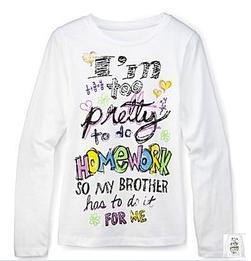
This t-shirt, along with a number of other controversial clothing items from several retailers, has caused an uproar among social media activists. I write about my response to the t-shirt wars in my latest piece for The Daily Muse. You can check it out here.
 Rikki writes.